Author: wayne warrington

  • Mafia Victim

    MAFIA VICTIM

    The Day My Father Disappeared—and the 24-Year Investigation That Revealed Why

    By Wayne B. Warrington Jr.

    On May 10, 1971, my father disappeared.

    His name was Wayne Barton Warrington Sr. He was forty-eight years old: a World War II veteran, a former Eisenhower White House aide, an Arizona public servant, a husband, a father, and at the time of his disappearance, the director of public affairs for the National Association of Food Chains in Washington, D.C.

    To the public, he was a respected man whose disappearance became a baffling national mystery.

    To me, he was my father.

    I was fourteen years old when he vanished. Old enough to understand fear. Old enough to understand that my father was missing. But too young to comprehend that one event could tear open a wound in a family and leave it bleeding for decades.

    My father had been traveling on business. He returned to Phoenix for a meeting, then stopped in Houston on his way back to Washington to visit a friend undergoing heart surgery. Investigators later determined that he returned his rental car at Houston Intercontinental Airport on the evening of May 10.

    His luggage continued on Eastern Airlines Flight 554 to Washington.

    My father did not.

    His suitcase arrived without him. His credit cards were never used again. His checking account went untouched. There was no ransom demand. No body. No grave. No final telephone call. No explanation that a wife could give her children when they asked where their father had gone.

    Only silence.

    For years, that silence became the central mystery of my family’s life.

    But my father’s disappearance did not begin in a Houston airport. It began in Washington, in the course of his work, with a product on grocery-store shelves bearing a harmless, environmentally conscious name: Ecolo-G.

    The Man Before the Mystery

    Before my father became a missing person, he had already lived a remarkable life of public service.

    Wayne B. Warrington Sr. was born on March 9, 1923, in Denver, Colorado. During World War II, he served in the United States Army Air Corps. After the war, he completed his education and devoted himself to work involving veterans, government service, and public policy.

    In 1953, he joined the Arizona State Highway Department, where he worked on traffic-safety matters. In 1954, Arizona Governor Howard Pyle appointed him Commissioner of Public Welfare.

    In 1956, my father moved to Washington, D.C., as Director of the Veterans Division of the Republican National Committee, helping mobilize veteran support for President Dwight D. Eisenhower’s re-election campaign.

    Then, in February 1957, Howard Pyle, serving in the Eisenhower administration, brought my father into the White House as a Special Assistant tasked with intergovernmental relations with state Governors. 

    The official records preserved by the Dwight D. Eisenhower Presidential Library confirm his White House service from 1957 through 1959. His work involved federal-state relations, government efficiency, transportation, education, natural resources, infrastructure, unemployment compensation, veterans’ matters, and briefing materials involving governors and national policy.

    He was also known as a speechwriter for the President and a man trusted to work in the background where discretion and judgment mattered.

    My father was not a celebrity politician. He was not someone seeking the spotlight. He was a public servant—a man whose life had been built around duty, loyalty, government, and the belief that doing the right thing still mattered.

    After leaving the White House, he returned to Arizona, later heading the Arizona Motor Vehicles Division and becoming involved in Senator Barry Goldwater’s 1964 presidential campaign.

    By 1971, he had returned to Washington as director of public affairs for the National Association of Food Chains, a major trade association representing grocery-store operators across the country.

    That position would place him in the path of something far darker than ordinary politics or industry controversy.

    The Detergent Called Ecolo-G

    In the early 1970s, environmental awareness was changing the American marketplace. Consumers were becoming concerned about pollution, chemical exposure, and phosphates in household products. Manufacturers responded with products promoted as safer, cleaner, and more environmentally responsible.

    One of those products was Ecolo-G, a laundry detergent sold through companies including Ecology Corporation of America and North American Chemical Corporation.

    The name sounded reassuring. The marketing suggested a product aligned with public health and environmental responsibility. However, Ecology Corporation served as a front for the Genovese crime family. 

    The federal record later revealed serious concerns.

    In March 1972, the Federal Trade Commission entered an order involving Ecology Corporation of America, North American Chemical Corporation, and their advertising agency concerning representations made about Ecolo-G. The FTC complaint stated that the product had been represented as safe and not hazardous, and that consumers had been led to believe no special precautions were necessary.

    The federal proceeding identified Ecolo-G as a hazardous substance requiring precautions to prevent swallowing it or allowing contact with eyes and skin. The companies were ordered to cease misrepresenting that the detergent was safe, not hazardous, or approved by any government agency.

    My father became involved before that federal action was resolved.

    As public affairs director for the National Association of Food Chains, he learned of consumer complaints and safety concerns involving Ecolo-G. Acting through his position, he sent a national telegram urging grocery-store members to suspend sales of the detergent.

    On its face, that should have been a straightforward consumer-protection action: if a product raised legitimate safety questions, remove it from shelves until those questions were answered.

    But Ecolo-G was not merely a consumer-product controversy.

    The detergent business had become entangled with organized crime.

    A United States Senate investigation into organized criminal activity in interstate commerce examined detergent sales involving North American Chemical, Best Sales, A&P, Nathan Sobol, Eugene Catena, Gerardo “Jerry” Catena, and others. The hearings addressed organized-crime influence in detergent distribution, the effort to force supermarket chains to carry products connected with mob-controlled business interests, and violence associated with resistance.

    Public reporting later stated that refusal by A&P to cooperate with a mob-linked detergent operation had been associated with sixteen firebombings and the killings of two grocery-store managers.

    My father had not knowingly entered a dispute with organized crime when he acted to protect consumers.

    But by telling grocery stores to suspend sales of Ecolo-G, he had interfered with commercial interests tied to men who did not settle disputes through ordinary business channels.

    He had touched something dangerous.

    The Threat Against My Father—and Against Us

    The public record tells only part of what happened next.

    My father was pressured to reverse course and cooperate. He refused.

    According to what he personally told me after I found him, along with the findings by the congressional investigation my mother and I attended in Washington, the threats then became direct, specific, and terrifying.

    The men threatening him did not merely warn him to stay out of their business. They told him where his wife and children were. While speaking with him on the telephone, they identified the locations of members of his own family, making the message unmistakable: they knew how to reach us, and if he continued to refuse them, they could kill us whenever they chose.

    My father was not dealing with a vague fear. He was dealing with people who had demonstrated that they knew where his children could be found.

    He also told me that he had verified through his counter-parts at the FDA, the deaths involving individuals who had offered far less opposition than he had. He understood that these threats were not theatrical intimidation. They were backed by a history of violence.

    Later, after my father’s story became public, I told a newspaper reporter that my father “realistically believed they were out there.”

    Those words were accurate, but standing alone they were inadequate.

    They did not explain that my father understood the people threatening him had demonstrated knowledge of his wife’s and children’s whereabouts. They did not explain that he knew other men had already died for offering lesser resistance. They did not explain that a man who has been threatened by organized crime does not suddenly become safe simply because months or years pass.

    Murders has no expiration date.

    My father did not need to have witnessed a killing to remain dangerous to the men he feared. He had opposed their interests. He had refused their pressure. He was scheduled to testify before congress as to his knowledge of the depth of organized crime within the Food and Drug markets. He knew enough to understand what was at stake. In his mind, that made him a threat to them for as long as he lived.

    And his family remained the easiest way to reach him.

    As the danger escalated, my father faced a choice no husband or father should ever be forced to make.

    He could remain visible, continue his career, return home to his wife and children, and risk leading men capable of violence directly to us.

    Or he could disappear and pray that if he removed himself, along with his pending testimony, he would also remove the reason to harm his family.

    On May 10, 1971, my father made that choice.   He disappeared.

    A Death Without a Body

    To the world, my father had vanished from an airport.

    To our family, it felt as though he had died without leaving a body behind.

    There was no funeral. No burial. No final goodbye. No place to go and grieve. Instead, there were unanswered questions that returned every day.

    Was he alive?

    Had he been abducted?

    Had he been murdered?

    Had he been buried somewhere under a name no one knew?

    Would someone someday explain why a husband and father simply vanished?

    Police and the FBI could find no direct evidence of his murder, and even with the mob claiming credit for his death in order to force others in authority to release the detergent back onto the market, we simply had to wait for physical evidence.  After seven years, he was declared legally dead.

    But a declaration of death does not end the suffering when there is no certainty behind it. It does not quiet the mind of a young boy wondering what happened to his father. It does not erase the possibility that somewhere, somehow, the truth still exists.

    The loss of my father altered the course of my life.

    I had once looked toward a future in law, politics, and public service—the worlds my father had inhabited. Instead, I found myself drawn into investigation. I needed answers. I needed to know what had happened to him. I needed to understand whether my father had been murdered, forced into hiding, or swallowed by something even larger than the threats we knew about.

    I did not know then that the search for my father would become a twenty-four-year investigation into the organized crime forces that had destroyed my family.

    The Son Who Refused to Let the Case Die

    During my early career in the investigative industry, I devoted years to my father’s disappearance case.

    I did not approach it as an old family story or a faded newspaper mystery. I worked it as an investigation. I traced records. I interviewed witnesses. I followed connections involving the detergent industry, organized crime, Washington, Houston, the Rental Car Employee being the last person to see him alive, and the events that had surrounded my father in the weeks and months before he vanished.

    What I uncovered went far beyond anything the public ever read in a newspaper.

    Over the course of that investigation, I obtained firsthand testimony concerning the Genovese crime family’s involvement in the events surrounding my father’s disappearance. I learned of neighbors who had witnessed evidence of a break-in at our family home. I developed information concerning surveillance teams watching our home in Bethesda, Maryland. I learned that the threats had not simply evaporated after my father disappeared; according to the evidence I developed, intimidation continued against individuals who stepped into matters connected with the work he had left behind.

    I also discovered that pursuing the truth carried its own danger.

    In Houston, where my father had last been publicly seen before his disappearance, I encountered threats and interference from law-enforcement individuals whom I understood to be attempting to stop my investigation rather than assist in solving it.  I learned the last person to see him alive, a Hertz Car Rental Clerk, had disappeared herself and somehow ended up being protected by local law enforcement and never listed in the FBI’s interview reports as being contacted. 

    That realization was chilling.

    As a son, I had spent years hoping that the institutions responsible for protecting the public might eventually help explain what happened to my father. Instead, I encountered individuals within law enforcement whom I believed were attempting to bury the investigation and their short and sweet “leave this alone or you will lose your license” position was not that of a friendly encounter with a department that should be supportive of my efforts. 

    But even that did not prepare me for the most terrifying moment of my search.

    It came through a man who spent months becoming my friend.

    He did not approach me as an enemy. He did not threaten me in some obvious way that would have immediately exposed him. He took the more calculated path. He entered my life slowly. He gained my confidence. He spent time beside me. He listened. He observed. He learned what I knew and what evidence I had accumulated. He became my friend.

    Then, after months of that manufactured friendship, he told me the truth.

    He disclosed that the relationship had been arranged. He had been placed close to me for the purpose of determining how much evidence I had gathered against the Genovese crime family and whether that evidence could damage them.

    And if I had enough evidence to pose a threat, he told me, he was to remove me from the equation. He reminded me that I had a son myself, and the family knew this. 

    There are moments in a person’s life when the world changes in a single breath.

    For years, I had been investigating the threats that had driven my father from his wife and children. I had been trying to understand the fear that could cause a man to abandon his identity and live underground for nearly two decades.

    Then I found myself sitting beside a man who told me that I, too, could be eliminated if I had learned too much.

    In that moment, my father’s fear was no longer something I had to reconstruct from records or conversations.

    I understood it.

    The danger had reached me.

    The same shadow that had fallen over my father’s life was now standing inside mine.

    And eventually, it reached toward my own child.

    As my investigation continued, efforts were made to redirect my focus away from what had happened to my father and toward the protection of my son, Wayne III. Whether intended to silence me, frighten me, or force me to choose between the truth and my child’s safety, the effect was unmistakable.

    I was now confronting the same impossible question my father had confronted in 1971:

    How far do you pursue the truth when the people you are pursuing make it clear that your child may be the price of continuing?

    For the first time, I understood the agony behind my father’s decision.

    That understanding did not erase the pain of losing him. It did not give back the childhood years his disappearance had taken from me. But it forced me to see him not merely as the father who vanished, but as a father trapped in a terror that had finally reached into my own life.

    While this interaction resulted in my coming into an agreement with this individual, the case remained alive in my heart and mind because it had never been merely an investigation. It was my father. It was my mother. It was my childhood. It was the destruction of a family by a crime family who believed fear could erase the truth.

    I needed to know what had happened to him. Then, after nearly eighteen years, I finally found him alive—and it happened by accident, through a fluke of fate: a government employee pushed the wrong button on a computer while updating Social Security payment records.

    Finding My Father

    The truth was almost impossible to absorb.

    My father had not been murdered in 1971.

    He had disappeared deliberately, knowing that there were powers within the government he could not trust, and those that would keep his disappearance a secret for reasons of National Security.

    For nearly eighteen years, Wayne B. Warrington Sr. had lived under assumed identities, moving through parts of the United States and Mexico before ultimately living in the Sacramento, California, area. The man who had once served in the Eisenhower White House, directed public affairs for a national food-industry association, advised political leaders, and lived a public life of responsibility had reduced his existence to anonymity.

    He worked low-profile jobs. He avoided the people and places connected to his past. He lived with the fear that if he resurfaced, the people he believed were hunting him would find him—or use his family to punish him.

    In 1988, while testing a database during my investigative work, I typed in my own name without including “Jr.” The search produced information that led me toward someone using my father’s name. Eventually, I discovered that Social Security benefits were being collected under his identity and sent through general delivery in Sacramento.

    My sisters and I attempted to locate him through the post office. When we could not make direct contact after weeks of surveillance, I left copies of my ID and a letter for him with a postal official.

    A day later, my father called.

    After almost eighteen years, the voice that had been missing from my life was suddenly there again.

    There is no simple way to describe what it means to find a father you have mourned, searched for, questioned, and imagined dead for nearly two decades.

    Relief does not arrive alone.

    It comes with bitterness. With grief. With disbelief. With a thousand stolen moments suddenly rushing back all at once. Birthdays he had missed. Holidays. Advice never given. Years in which his children became parents and was for me an adult without him. Years in which my mother lived without her husband.

    I finally had my father back.

    But I had also finally learned the depth of what had been taken from all of us.

    He told me why he had disappeared. He told me about the threats. He told me that the danger had included his wife and children. He told me why he believed staying away was the only choice that could protect us.

    My father had not stopped loving us.

    He had disappeared because he loved us enough to believe that removing himself from our lives might save them.

    Reuniting My Parents

    One of the most meaningful things I was able to do after finding my father was reunite my parents.

    They had been separated for nearly eighteen years.

    Neither had remarried.

    My father had lived underground, isolated by fear and secrecy. My mother had lived without answers, without closure, and without the husband whose disappearance had left our family in a permanent state of uncertainty.

    When they were finally brought together again, I witnessed something I will carry with me for the rest of my life.

    It was as though the eighteen years apart briefly disappeared.

    Watching them together, I saw what looked like two high school sweethearts reunited after a lifetime of separation. They were older. They were wounded. They had been robbed of more time than any husband and wife should ever lose.

    But the love and spiritual connection between them was still there.

    It was immediate. It was gentle. It was soulful.

    The criminal element that had driven my father into hiding had stolen nearly eighteen years from their marriage. They had stolen nearly eighteen years from his children. They had stolen the ordinary moments that make up a family’s life.

    But they had not destroyed the love.

    For a brief period, my father was no longer simply a missing person, a former White House aide living under an alias, or the subject of an investigation I had carried for most of my adult life.

    He was my father again.

    He was my mother’s husband again.

    And our family finally understood the truth of his disappearance.

    My father had not walked away from his family.

    He had sacrificed his life with us because he believed it was the only way to protect ours.

    By the time we found him, he was gravely ill with emphysema and hiding it from me. He wanted me to see him strong and able to take care of his wife without my help. My mother remained with him in northern California during the months before his death.  

    Wayne B. Warrington Sr. died in Sacramento on January 3, 1989. I was there, holding his hand and whispering to him, letting him know it was all right now: “I’ve got our family.” With that, he passed in peace.

    I had found him only about seven months before his death.

    After eighteen years of searching, the time we were given back was measured in months.

    The Story Becomes Public

    I did not immediately reveal the truth publicly after finding my father.

    He was still afraid.

    Even after all those years in hiding, even while dying of emphysema, my father remained convinced that the threat had not simply vanished with time. I respected that fear because by then I had experienced enough in my own investigation to understand that it was not an irrational fear.

    In 1991, approximately two years after my father’s death, his story became public.

    The Arizona Republic reported the story, which was republished nationally by The Washington Post. The New York Times also reported that the former White House aide had hidden from the mob for eighteen years.

    The headlines captured the extraordinary outline of the story: a former White House aide disappeared in 1971; his luggage arrived in Washington without him; his family believed him dead; nearly eighteen years later, his son found him living under assumed identities; and fear of organized-crime retaliation had driven him underground.

    But those articles could only report a fraction of the full story.

    They reported that my father feared the mob.

    They did not fully explain that the threats had included the lives of his wife and children, or that the threats came not simply from the mob, but also from the highest level of the government which created a totally different element of danger that he did not want our family to be subjected to. 

    They reported that I found him.

    They did not report the full extent of the twenty-four-year investigation, the witnesses, the surveillance information, the break-in evidence, the interference I experienced, or the man who spent months gaining my trust before telling me he had been assigned to determine what I knew and eliminate me if necessary.

    They reported that my father had hidden for eighteen years.

    They could not explain what those eighteen years did to the family he left behind.

    The newspapers documented the disappearance.

    My family lived the case.

    The Inheritance My Father Left Me

    My father’s disappearance permanently altered the direction of my life.

    As a young man, I once considered a path connected with law, government, and perhaps politics. Those were worlds my father had known. He had served in public office, worked in the White House, participated in national politics, and built a career rooted in public responsibility.  At 14 years old, my path, my education, my service within the Federal government had already been set in stone.

    But after what happened to him, my life took another direction.

    Instead of Georgetown University, I studied law in Arizona, and I became an investigator and consumer advocate because I had seen, inside my own family, what can happen when dangerous products, organized crime, intimidation, corruption, and institutional failure converge.

    My father took action because he believed consumers were being placed at risk.

    He disappeared because he believed his family was being placed at risk.

    I followed up on the investigation because I refused to allow threats, silence, fear, or the passage of time to become the final version of what happened to him.

    For more than forty years, my professional life has centered on protecting consumers, investigating fraud, exposing wrongdoing, and helping people recover what has been taken from them. Through my consumer-advocacy work and the LostMoney Consumer Reports resources published at waynewarrington.com/blog/, that work has helped millions of Americans locate and recover billions of dollars in lost, missing, or unclaimed funds.

    But the origin of that work was never simply professional ambition.

    It was personal.

    It began with a fourteen-year-old boy whose father disappeared.

    It grew through the years I spent trying to discover what had happened to him.

    And it became permanent when I finally learned that my father had sacrificed almost eighteen years of his life with his family because he believed he was protecting us from the mafia willing to kill.

    There will be people who read this story and assume that such threats belong only in movies, novels, or old crime dramas. They may believe that if every detail did not appear in a newspaper article or a government report, then it could not have happened.

    My family learned otherwise.

    Sometimes the public record contains only the surface of the truth.

    Sometimes threats are real.

    Sometimes organized crime reaches into ordinary homes, marriages, and children’s lives in ways the public never sees.

    Sometimes the father who disappears is not abandoning his family.

    Sometimes he is sacrificing himself for them.

    Wayne B. Warrington Sr. was my father.

    He was a veteran, a public servant, a White House aide, a husband, and a father.

    He was a man who acted to protect consumers and then lived the remainder of his life believing that doing so had placed everyone he loved in danger.

    He was also a victim of the Mafia.

    The men who threatened him took nearly eighteen years of his life with his wife and children.

    They did not take his love for us.

    They did not take the truth.

    And they did not stop his son from telling the story.


    Documentation and Supporting References

    This article is a true-story account written by Wayne Warrington., son of Wayne B. Warrington Sr. It is based upon public government records, published newspaper accounts, congressional materials, Federal Trade Commission records, the author’s approximately twenty-four-year personal investigation, witness information developed during that investigation, the author’s direct experiences, and conversations with his father after locating him in hiding.

    The public sources listed below document significant portions of the historical record, including Wayne B. Warrington Sr.’s government service, the Ecolo-G detergent matter, the Senate investigation into organized-crime activity involving detergent sales and supermarket chains, his 1971 disappearance, his years in hiding, his death, and his discovery by his family.

    The complete story includes evidence and firsthand experiences that were never fully reported in public media accounts, including the specific threats described by Wayne B. Warrington Sr., investigative information developed by Wayne B. Warrington Jr., and direct encounters experienced during the investigation.  The disappearance of Wayne B Warrington, Sr created national media interest and a major network interest in a true story movie series. The movie rights and contracts were abandoned when Wayne B. Warrington Jr. would not release creative rights to allow the studio/network to remove the federal government’s cover up as to the 1971 White House involvement with members of the mafia.   Sometimes, some elements never come to light, as they should. 

    Public Record References

    1. Dwight D. Eisenhower Presidential Library — Wayne B. Warrington Records, 1953–1959

    Official archival record confirming Wayne B. Warrington’s service as Director of the Veterans Division of the Republican National Committee in 1956 and as Special Assistant in the White House Office from 1957 through 1959.

    https://www.eisenhowerlibrary.gov/research/finding-aids/warrington-wayne-b

    PDF Finding Aid:

    https://www.eisenhowerlibrary.gov/sites/default/files/finding-aids/pdf/warrington-wayne-records.pdf

    2. The Washington Post / Arizona Republic — “1971 Disappearance of D.C. Lobbyist Solved by Son, a Private Investigator: Fear of Mob Drove Former White House Staff Aide Underground,” November 17–18, 1991

    Published reporting documenting Wayne Warrington Sr.’s disappearance, his position with the National Association of Food Chains, his last known public appearance at Houston Intercontinental Airport, the arrival of his luggage in Washington without him, the Ecolo-G detergent matter, his years living under false identities, his death in Sacramento, and his discovery by his son.

    https://www.washingtonpost.com/archive/politics/1991/11/18/1971-disappearance-of-dc-lobbyist-solved-by-son-a-private-investigator/a6edc8a3-6f69-47ad-983f-209025e637d9/

    3. The New York Times — “Ex-White House Aide Hid From Mob for 18 Years, Son Says,” November 30, 1991

    Published national account reporting that Wayne Warrington Sr., a former White House aide, lived in hiding for eighteen years because of fear of organized-crime retaliation.

    https://query.nytimes.com/gst/fullpage.html?res=9D0CEFDD153AF933A05752C1A967958260

    4. Federal Trade Commission — In the Matter of Ecology Corporation of America, North American Chemical Corporation, and Venet Advertising Inc., Docket C-2179, Decision and Order, March 30, 1972

    Official federal proceeding concerning advertising and safety representations made about Ecolo-G detergent. The FTC order identified Ecology Corporation of America and North American Chemical Corporation as sellers and distributors of Ecolo-G and prohibited representations that the detergent was safe, not hazardous, required no special precautions, or had received government approval.

    https://www.ftc.gov/sites/default/files/documents/commission_decision_volumes/volume-80/ftc_volume_decision_80_january_-_june_1972pages_408-477.pdf

    5. Federal Register — Federal Trade Commission Consent Order Concerning Ecolo-G Detergent, April 20, 1972

    Federal publication reporting the FTC order concerning Ecolo-G and the prohibited safety and government-approval representations associated with its marketing.

    https://www.govinfo.gov/content/pkg/FR-1972-04-20/pdf/FR-1972-04-20.pdf

    6. United States Senate Committee on Commerce — Effects of Organized Criminal Activity on Interstate and Foreign Commerce, Hearings Held October 5, 6, 7, 8, and 15, 1971; Published 1972

    Congressional hearing record addressing organized-crime activity affecting interstate commerce, including references to Ecolo-G, North American Chemical, Best Sales, A&P, Nathan Sobol, Eugene Catena, Gerardo Catena, detergent distribution, organized-crime influence, and supermarket-chain resistance.

    https://books.google.com/books?id=FRDxu__U_9AC

    7. University of Arizona Libraries, Arizona Historical Indexes — Wayne Barton Warrington

    Archival listing identifying Don Bolles’ 1973 reporting on the disappearance of Wayne Warrington, reflecting the public mystery that remained unresolved after his disappearance.

    https://uamr.lib.arizona.edu/subject-headings/warrington-wayne-barton

    8. Time Magazine — “Products: As the Soapers’ World Turns,” March 7, 1971

    Contemporary reporting concerning the market for environmentally promoted detergents and North American Chemical’s distribution of Ecolo-G during the period preceding Wayne Warrington Sr.’s disappearance.

    https://time.com/archive/6838641/products-as-the-soapers-world-turns/

    9. waynewarrington.com/blog/ — “Mafia Victim”

    The author’s published account and continuing preservation of the life story of Wayne B. Warrington Sr., his disappearance, and the family legacy arising from those events.
    https://waynewarrington.com/blog/mafia-victim/

  • ANNOUNCEMENT: Wayne Warrington Expands Professional Services

    to Include Full Regulation D Due Diligence & Compliance Support

    For more than four decades, Wayne Warrington has stood as one of America’s most trusted investigative and due-diligence professionals. With over 45 years as a licensed private investigator, combined with 20+ years in securities, financial, background, and asset investigations for Fortune 100 companies, major financial institutions, and state and federal agencies, Wayne has built a national reputation for precision, integrity, and results.

    Today, Wayne Warrington is proud to announce the formal expansion of his services to include comprehensive Regulation D Due Diligence, supporting issuers, fund managers, attorneys, broker-dealers, and investors operating under SEC Regulation D Rules 504, 506(b), and 506(c). To book a 15 minute call with Wayne to discuss your case, please use this link.


    Why This Expansion Matters Now

    Capital formation in private markets continues to grow at historic levels. With increased SEC scrutiny, heightened investor expectations, and more frequent enforcement surrounding Bad Actor Disqualifications and Accredited Investor Verification, the need for independent, qualified due-diligence professionals has never been greater.

    Wayne’s new suite of Regulation D services fills a critical market gap:

    • Independent third-party verification
    • Investigator-level compliance checks
    • Experienced guidance for issuers and investment professionals
    • Protection for investors and sponsors against avoidable regulatory risk

    Industry-Leading Expertise You Can Trust

    Wayne’s professional background is unmatched in the private-offerings compliance landscape:

    45+ Years Licensed Private Investigator

    Maintaining full active licensing status across decades in good standing.

    FBI Background Clearance, Professional Bonds & Insurance

    A level of trust and credentialing rarely found among due-diligence professionals.

    20+ Years in Securities & Financial Investigations

    Supporting major law firms, Fortune 100 companies, and multiple federal agencies.

    Leadership Roles at State & National Industry Associations

    Chairman, President, Regional Director, and Legislative Industry Chairman—shaping compliance standards nationwide.

    5+ Million Consumers & Thousands of Businesses Served

    A trusted expert to both the public and private sectors.

    Top Investigative Intelligence Contractor for Federal Agencies

    More than 20 years of specialized investigative support for national-level operations.

    A 40-Year Record of Professional Excellence


    New Regulation D Due Diligence Services

    Wayne’s expanded offering includes the following core services, aligned with current SEC requirements:


    1. Regulation D “Bad Actor” Due Diligence (Rule 506(d))

    A full investigative review of:

    • Issuers
    • Executive officers & directors
    • 20% beneficial owners
    • Promoters
    • Placement agents / finders
    • Investment managers & key advisory personnel

    Checks include:

    • SEC, FINRA, and state regulatory actions
    • Criminal records (federal, state, county)
    • CFTC, state securities boards, and banking regulators
    • Civil litigation, judgements, and investor actions
    • Global sanctions & watchlists
    • Corporate history, affiliations, and prior offerings

    This ensures the issuer remains eligible to rely on Rule 506(b) or 506(c) exemptions.


    2. Accredited Investor Verification (Rule 506(c))

    Providing the “reasonable steps to verify” required by the SEC:

    • Income verification
    • Asset and liability analysis
    • Third-party documentation review
    • CPA/attorney letter validation
    • Enhanced identity and fraud screening

    All procedures adhere to SEC interpretive guidance and industry best practices.


    3. Executive, Partner & Principal Background Investigations

    Complete investigative profiles for:

    • Key executives
    • Founders
    • Managers
    • Board members
    • Placement agents
    • Investor partners

    4. Reputation Risk & Compliance Exposure Assessment

    Independent review of:

    • Litigation risk
    • Prior business failures or regulatory actions
    • Conflicts of interest
    • Undisclosed liabilities
    • Social, online, and deep-web presence
    • Operational credibility indicators

    5. Investor-Facing Due Diligence Support

    Wayne also provides services designed to protect investors, including:

    • Independent third-party review of offerings
    • Analysis of issuer representations
    • Review of financial claims, backgrounds, and offering materials
    • Risk scoring & fraud-indicator assessments

    A Trusted Partner for Issuers, Investors & Legal Teams

    Whether a company is raising $1 million or $150 million under Regulation D, compliance failures—intentional or inadvertent—can result in:

    • Disqualification from exemptions
    • Forced rescission offers
    • Investor litigation
    • Regulatory enforcement
    • Loss of future capital access

    Wayne’s services are designed to prevent these outcomes by ensuring full compliance, accurate documentation, and proven investigative rigor.


    Availability & Engagement

    Reg D Due Diligence services are now available to:

    • Issuers
    • Private funds
    • Real estate syndicators
    • Broker-dealers
    • Registered investment advisors
    • Attorneys & compliance teams
    • Individual accredited investors
    • Family offices
    • Investment groups

    Each engagement is customized to meet regulatory needs, risk level, and offering structure.


    About Wayne Warrington

    Wayne Warrington is a nationally recognized investigative expert, consumer advocate, and senior due-diligence professional with 45+ years in private investigation and more than two decades specializing in financial and securities-related investigations. He has supported more than five million consumers and thousands of businesses and government agencies, including federal investigative and intelligence operations.

    With a four-decade record of perfect standing, Wayne is widely regarded as one of the most reliable and trustworthy investigative professionals in the United States.

  • The American Reset: Trump’s “Big Beautiful Bill”

    The American Reset: Trump’s “Big Beautiful Bill”

    How it aligns with FarSuperior’s Vision for a New Economic Era

    By Wayne Warrington | FarSuperior Insights | June 2025

    Ball of confusion and conflicting narratives — that’s what the world is today. The economy is no exception. For years, America’s small business owners and middle-class families have struggled under the weight of inflation, bureaucratic overreach, and digital platforms that harvest personal data without consent or reward. But amid the noise, a quiet revolution is gaining momentum.

    President Donald J. Trump’s “Big Beautiful Bill,” now advancing through the US Senate, is more than a tax policy — it’s a strategic reset designed to reinvigorate the American economy. And for communities like FarSuperior, it’s the validation of a belief we’ve held for decades: that prosperity can be decentralized, dignified, and returned to the people.

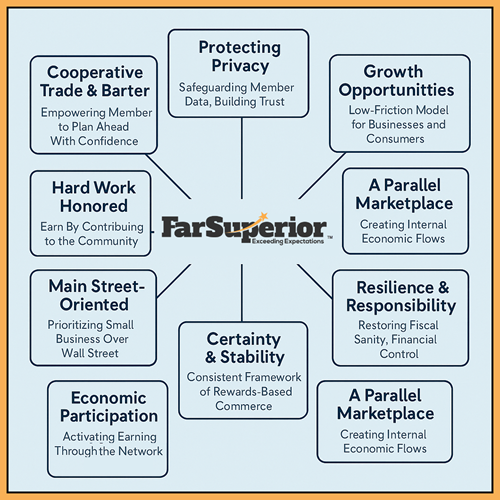
    This bill, crafted with surgical precision, outlines a nine-point plan for long-term economic stabilization. But what’s most remarkable is how its pillars resonate with the values and mechanisms already at work within the FarSuperior Community Model — our alternative ecosystem for small business, conscious consumers, and privacy-minded citizens.


    1. Certainty Creates Confidence

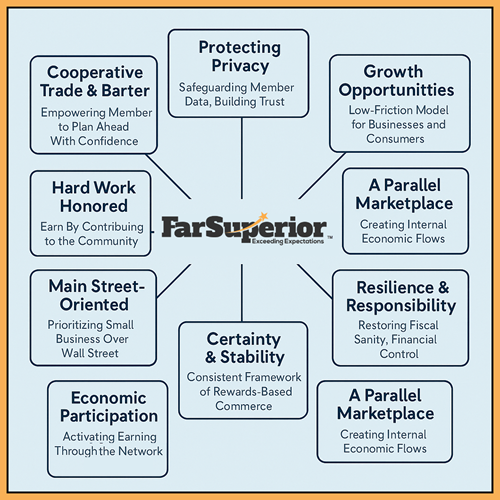
    By making the 2017 Trump Tax Cuts permanent, this bill ends the era of policy whiplash. Businesses and families can finally make long-term plans — to hire, invest, and grow. While Democrats claim that Trump’s agenda is to tax the middle class, his efforts and actions are the opposite. At FarSuperior, we echo this call for stability. Our ecosystem isn’t based on short-term gimmicks. We offer a consistent framework of cooperative trade, barter, and reward-based commerce that empowers members to plan ahead with confidence.


    2. Protecting the Paycheck

    The elimination of taxes on tips and overtime puts real money back into the hands of working Americans. It’s not just a tax break — it’s a declaration that hard work should be honored, not penalized. This dovetails with FarSuperior’s member incentives: when you contribute, refer, or trade in the community, you earn. We honor effort with economic reward — not handouts, but opportunity. The only piece of the elimination on taxes, is the tax on Social Security benefits, which to this writer is a crime against our elderly.

    “Social Security was never meant to be taxed—but now many middle-income retirees are losing up to 85% of their benefits to the IRS. That’s why FarSuperior created a tax-free dividend and rewards program—to help restore financial dignity and control to our members in retirement.”
    — Wayne Warrington, Founder of FarSuperior


    3. Main Street Over Wall Street

    This bill prioritizes small businesses — America’s economic backbone — by removing red tape and expanding capital access. At FarSuperior, we built an entire infrastructure for local entrepreneurs to thrive without relying on gatekeepers. Our platform is a Main Street-first ecosystem, where local trades, partnerships, and community-based growth take center stage.


    4. Restoring Fiscal Sanity

    The rollback of COVID-era spending programs signals a return to responsibility. Likewise, FarSuperior members learn to reclaim control over their financial lives — not by waiting for stimulus checks, but by activating earning potential through participation in the network. Structured, principled, and fair — that’s how we grow together.


    5. Revenue from Resilience

    Trump’s use of tariffs to bring in over $200 billion annually — even as Washington ignores the data — is a lesson in alternative revenue generation. Similarly, FarSuperior’s model creates internal economic flows through member trade, advertising exchanges, and rewards. We are building a parallel marketplace where value is created and shared, not siphoned off by middlemen.


    6. Tackling the Deficit from the Ground Up

    While D.C. argues over numbers, this bill begins to slow the fiscal bleeding. But real deficit correction starts at the household level. Our cooperative platform reduces financial dependency by helping members save money, earn rewards, and monetize data they already produce every day.


    7. Unleashing Growth Through Deregulation

    Overregulation is a hidden tax. Trump’s bill cuts this burden, freeing industries to thrive. FarSuperior embraces a low-friction model where businesses connect directly with customers, use simplified platforms, and operate without the crushing costs of digital gatekeepers or data brokers.


    8. Safeguarding the System

    The bill also shores up the Treasury market by enabling U.S. banks to absorb more debt and prevent auction failures. At FarSuperior, we take a similar approach to digital trust — by safeguarding member privacy, protecting data, and building resilient internal systems, we insulate our users from external shocks and surveillance capitalism.


    9. Planning for 2026 and Beyond

    Make no mistake: this bill is a prelude to a broader transformation. It prepares the ground for 2026 — a potential new era of fair trade, deregulation, and tax simplicity. And FarSuperior is already there. We are not just reacting to policy; we are building the next economy today — one trade, one reward, one connection at a time. We are building upon our original 1999 Business Model with today’s AI being controlled by FarSuperior’s Responsible AI system, and incorporating our “Back to Basics” sales process which keeps the human element as a mission critical part of the community structure.


    The Path Forward

    The mainstream media may dismiss this legislation as political theater. But at FarSuperior, we see something different: the outline of a national comeback — and a reflection of the work we’ve already begun. Talk about being divinely guided to protect God’s children. 🙂

    The American economy doesn’t need more slogans. It needs actionable systems that restore dignity, self-reliance, and community wealth. Trump’s “Big Beautiful Bill” lights the fuse on a larger reset — and FarSuperior is prepared to carry that torch forward, into every town, neighborhood, and business across the country.


    Are you ready to stop renting your data, start owning your economic potential, and become part of the real American revival?

    Join the FarSuperior Movement — where privacy meets prosperity. TEXT the word REVIVAL to 802-430-6322 Today!

  • The Rise of Fake Profiles on Facebook

    The Rise of Fake Profiles on Facebook

    A Warning to Professionals and Mature Users

    Over the past few years, I’ve noticed a disturbing and increasingly aggressive trend on Facebook — and it’s something more people should be talking about.

    As a business professional in my 60s, I’ve always enjoyed connecting with peers, entrepreneurs, and like-minded individuals through social media. But what began as the occasional suspicious friend request has grown into a weekly — sometimes daily — flood of messages from profiles that are almost certainly fake.

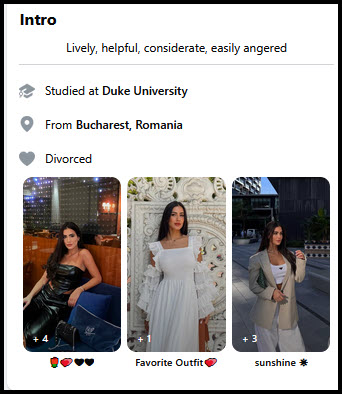
    At first glance, these profiles often seem legitimate: attractive women claiming to be successful fashion entrepreneurs or investors, often located in major U.S. cities like Los Angeles, New York, or even my home state. Their friend request comes with a soft, seemingly harmless message like:

    “I was a little curious when I saw you appear in my friend recommendations, so I added you without knowing why. I hope I didn’t disturb you, and I’m sorry.”

    Sounds polite, right? But what follows is anything but innocent.


    The Conversation Trap

    Once you accept the request or reply, the dialogue begins. And it always follows a pattern:

    • They ask about your age, location, and occupation.
    • They claim to be “curious” about your business success, and would love to be mentored by you.
    • They express a feeling of personal connection with you, and the age difference is never an issue for them.
    • They often pivot quickly to discussions about investing, usually in gold or cryptocurrency.
    • They try to move the conversation to WhatsApp almost immediately. In one case I forced the communication to a more secure platform “Signal” explaining I can NOT use WhatsApp for privacy reasons. When the “fake profile person” agreed to set up a conversation on Signal, it appeared under a totally different name, which she claimed to be her mother’s account. 🙂
    • They never want to speak on the phone, or simply avoid phone conversations where you would be able to have a point of reference or contact info that law enforcement can use against them.
    • They often claim to be originally from Europe or Russia, but now live in the U.S.

    And if you share anything remotely personal — such as your interests, lifestyle, or family — they latch on and begin chatting with increased frequency. Soon, you’re fielding messages throughout the day.

    It’s not just an annoyance — it’s an outrageous waste of time and, worse, a serious threat to your digital privacy.


    The Real Danger: Social Engineering

    These aren’t lonely hearts looking to connect. They’re part of organized efforts to extract personal data, build psychological profiles, and possibly target victims for fraud, scams, or blackmail.

    They want to know:

    • What you like and dislike
    • Who your family members are
    • Whether you have children
    • Your exact age
    • Whether you own a business
    • What you invest in or how you make money

    In short, they’re building a digital dossier that can be sold, reused, or exploited in various forms of cybercrime. This is social engineering — not conversation.


    Why Isn’t Facebook Stopping It?

    Despite Facebook’s vast resources and AI systems, fake accounts continue to flourish. Here’s why:

    • Fake profiles are made to look authentic — with real photos (often stolen) and believable bios.
    • Scammers send personal 1-on-1 messages that bypass mass-spam filters.
    • They exploit the “People You May Know” feature to get into your social circles.
    • And Facebook, frankly, has a poor track record when it comes to proactive moderation.

    Fake Facebook Profiles

    How You Can Protect Yourself

    • Don’t accept friend requests from strangers — no matter how attractive or professional their profile looks.
    • Watch for scripted messages that seem overly polite or oddly generic.
    • Never move conversations to WhatsApp or another messaging platform unless you personally verify the identity.
    • Don’t share personal or financial information with anyone online, especially in a first conversation.
    • Screen the Friend Request first by looking for these “fake profile” indicators. Small number of friends under 200, and only 1 to 5 friends in common. Beautiful photos that only have 0 to 10 likes and virtually no comments. Remember, the lower the number of connections, friends, likes means they have just recently created the profile (within a year) and not many people interact with them since they do not know them personally.
    • Report fake profiles — even if it feels futile. The more reports, the more likely Facebook will take action.

    Final Thoughts

    The emotional and digital cost of engaging with fake profiles is high — and growing. As someone who values authenticity, privacy, and meaningful connection, I feel it’s important to sound the alarm. As a consumer advocate working with millions of consumers over the past three decades, I find it disturbing that big tech firms such as Facebook are not doing more to reduce, minimize the millions of fake profiles such as these. Business Incentive: Meta has historically favored engagement over safety, and every profile (fake or not) drives activity metrics. Outside of these fake profiles, the more disturbing activity on Facebook is FAKE or Fraudulent Advertisements/Sale. which I have been reporting on for years. I’ll cover this more in another article.

    As for new friend requests, or Chat’s initiated by people you do not know, if you’ve experienced this pattern, you’re not alone. Let’s speak out, raise awareness, and help protect each other from this new form of online abuse. Remember, knowledge is KING! Your data is extremely valuable and the more information they have on you, your likes, dislikes, family, locations, age, income, occupations, etc. the more MONEY $$$ the scammers make from their data collection efforts. So even it they are not attempting to get you intimately attached to them, or planning on asking you to invest in their gold or crypto system, they may simply building a profile through the use of AI, Bots and Automated systems, and the next thing you know you have purchased a villa in the south of France that you never knew about. 🙁

    Let’s make our future interaction online safe, consumer friendly and profitable… for US, not them! 🙂 I invite you to join me as a member of our FarSuperior communities online, www.FarSuperior.com and learn more about you owning the Internet and not the other way around. God bless and may 2025 be the best year yet for you and yours. Wayne

  • Trust ~ A Wait-and-See Approach

    Trust ~ A Wait-and-See Approach

    As a small child growing up, I remember how my parents always watched over me and protected me. As a young parent, I recall approaching a busy street with my son, extending my hand and saying, “Take my hand, and look both ways.”

    We learn to trust based on relationships where trust plays a role. In a parent-child relationship, trust is built from day one and grows over time as love is shared and reinforced. In a government-citizen relationship, trust is assumed—we elect individuals whom we believe will act in our best interests, uphold their promises, and protect our rights to life, liberty, and the pursuit of happiness. One of the affirmations of this trust is cemented in our minds when we hear an elected official swear an oath before God, pledging to protect and defend the Constitution of the United States against all enemies, both foreign and domestic.

    Five years ago, we the people were asked to trust our government when we were told: “Take this shot, and do not worry about any side effects.” That moment will forever mark a massive shift in our reality, in our trust, and in our relationship with those in power—a shift that will impact generations to come. This is not to say that millions of Americans didn’t already have faith in our government, or that conspiracy theories weren’t already circulating. But in that moment, suspicions about elected officials using their positions for personal gain, consolidating power, or misleading the public finally reached a breaking point. What once seemed like theories became real concerns for the majority of Americans, and today represent a nightmare for millions of us.

    Today, we find ourselves in a paradigm shift—one where TRUST is no longer an automatic element of a relationship. Instead, it has become a ‘Wait and See’ approach, at least where the government, food manufacturers, big tech, and pharmaceutical companies are concerned.

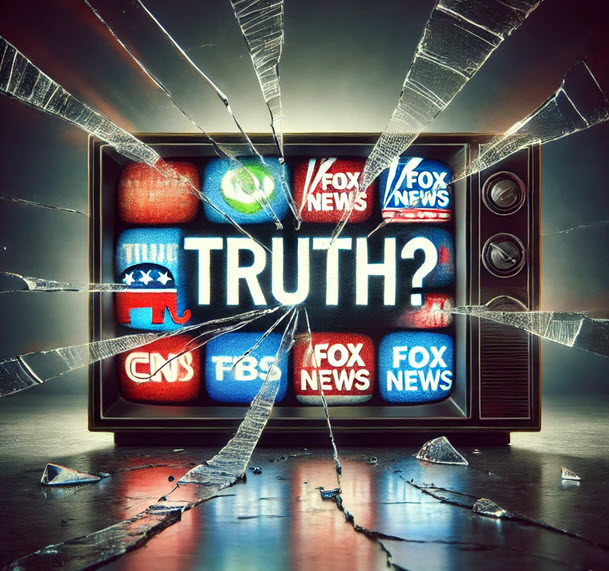
    One area where trust has all but disappeared is in legacy media, where it is no longer even a ‘wait and see’ situation. We know they are biased—bought and paid for by special interests and powerful elites.

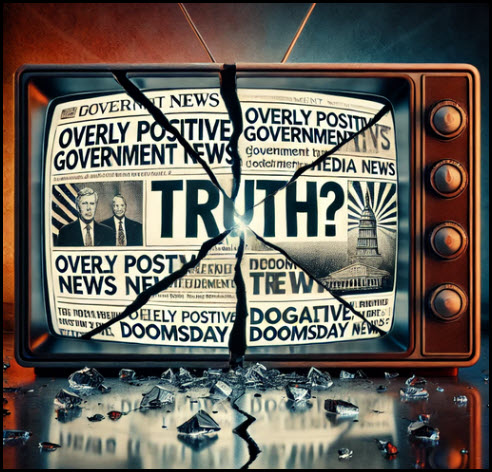
    This morning, as I began my day with prayer and meditation, I glanced at my phone and noticed incoming news updates. Next to it was another smart device used for medical functions, which also receives news feeds. As I reached to silence both devices to avoid interruptions, I noticed something peculiar—the headlines on one phone painted the government in a positive light, while the other took an almost doomsday approach.

    Of course, we all know that news outlets today cater to different audiences—some lean right, some lean left. But as I placed the phones side by side and scrolled through article after article, video after video, I had a Twilight Zone moment. It felt like I was looking at two completely different versions of America. It reminded me of an old Star Trek episode depicting alternate realities of Earth.

    With such starkly opposing narratives, is it any wonder that when a Republican speaks to a Democrat, they often walk away shaking their heads, wondering what planet the other is living on—and what, exactly, they must be smoking?

    Finding Common Ground Again

    I for one, being raised in a family with close friends/family in both state and federal elected government offices, remember a time—not too long ago—when Democrats and Republicans could sit across from one another, debate issues, and still walk away with mutual respect. Differences of opinion were not seen as an attack on one’s character, but rather as the foundation of a healthy democracy. Today, that respect and open dialogue have all but disappeared, replaced by division, hostility, and an “us vs. them” mentality that is counterproductive and, frankly, destructive to the very fabric of our nation. If we are to move forward as Americans, we must find our way back to the center—a place where disagreements are met with discussion, not disdain, and where unity is valued over party loyalty.

    Right now, we have a new administration in office. A President and cabinet that, by all accounts, are delivering exactly what they promised. Four years ago, those on the left asked the right to “wait and see” what the former administration could do to Build Back Better. The right waited. And we saw. Now, the right is asking the left for that same courtesy—to wait, to see, and to allow the current administration time to fulfill its promises. The American people, both through the Electoral College and the popular vote, made a choice. We owe it to ourselves and to one another to give that choice the opportunity to unfold before rushing to judgment.

    Perhaps the best way to do this is by simply turning off the noise. For the next six months, challenge yourself to step away from the constant stream of media—no left-leaning outrage, no right-leaning conspiracies, just life. Focus on your family, your community, and the real world around you. Then, in six months, take a fresh, unbiased look at what has been accomplished.

    Most of us, regardless of party affiliation, want the same things: safe neighborhoods, good schools, affordable food, effective law enforcement, fair elections, freedom of speech, privacy and protection over our homes, and public servants who work for us, not themselves. These are not Republican or Democratic ideals—they are American values. If we can set aside our differences long enough to recognize our shared goals, we may just find that trust—though shaken—is not beyond repair.

    I close with this: God created man in His own image, with the intention that we live in peace and love one another. Satan’s design for this world is the opposite. So, ask yourself—who or what is driving the division among God’s children? And which side of good versus evil do you choose to stand on? The choice is clear. Just don’t allow the legacy media to make it for you.

    To my friends and visitors here, may God’s blessings of peace, good health and happiness fill your life. Wayne Warrington

  • Unlock Your Hidden Wealth

    Unlock Your Hidden Wealth: A Guide to Finding Lost Money

    LostMoney,com the original and official site for unclaimed property recovery since 1996

    Did you know billions of dollars in lost money are sitting untouched, waiting for their rightful owners? Whether it’s forgotten bank accounts, uncashed checks, or security deposits, this hidden treasure could belong to you. Here’s how to claim it:

    Start Your Search

    Begin by gathering personal details like your name, social security number, and past addresses. These help trace any lost assets tied to you.

    Dive Deeper

    Look for old account numbers, employer details, or insurance policies that may hold forgotten assets. Each state holds lost property, and you can search for it through official state or national databases.

    To search for lost money from relatives, follow these steps:

    1. Search by Location: Start by searching for the state where your relative lived, followed by the term “lost money.” You’ll find official websites where you can begin your search.For example, if your relative lived in Ohio, you can look for Ohio’s lost property database.
    2. Enter Details: You’ll need to input some basic information about the person, such as their name, city, business, or zip code. Any lost money associated with that information will show up.
    3. Submit a Claim: If your state offers online claims, you can directly submit a claim. If not, you may need to fill out paperwork. Keep in mind that you’ll need to prove your connection, especially if the person is deceased.

    Reclaiming Your Property

    Lost money can come in many forms: from old bank accounts and uncashed checks to stock certificates, utility deposits, or insurance policies. When an institution cannot locate the rightful owner, these funds are handed over to the state or federal government, waiting for you to claim them. If you’re claiming on behalf of a deceased relative, you will need to provide proof of relationship to make the claim.

    Confirmation Email and Proof of Identity

    Once you file a claim, you’ll receive a confirmation email outlining the next steps. For instance, you might need to upload documents to prove your identity and connection to the lost money. This often includes government-issued ID, proof of address, Social Security number, and legal documents (such as death certificates or wills).

    Protect Yourself

    Avoid third-party services charging fees for locating lost money. Instead, rely on official state or federal websites or avail yourself of the free consumer reports and search assistance at LostMoney.com. Always double-check any online resource before sharing sensitive information. A good example of this is the only entity that needs your social security number will be the holder/trustee that actually has the money/accounts you can claim. A search firm does not need your SSN to achieve success for you.

    Conclusion

    While you may not become a millionaire, reclaiming lost money is a simple way to uncover forgotten assets. Take a few minutes to start your search and see if you have hidden treasure waiting for you.

  • They Have Won the Battle!

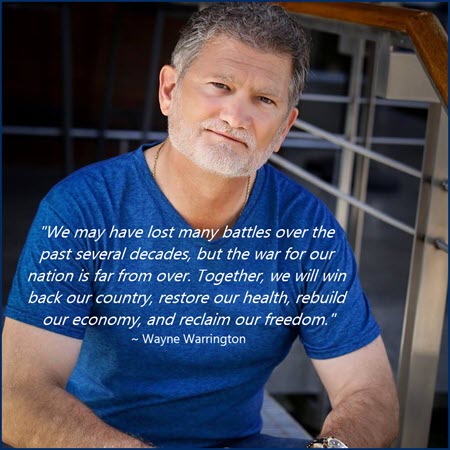
    But Together, We Can Win the War!

    In America, and in many countries around the world, we find ourselves in a state of virtual civil war—not with foreign enemies, but among our very own neighbors and even within our own families. This deep division didn’t happen overnight, nor did it emerge through logical progression within the framework of our country’s model or design. Instead, the condition we find ourselves in mirrors the stated objectives of two powerful outside forces, both harboring ill intentions toward the people of the United States of America.

    The Communist Infiltration: A Silent War

    In the 1960s, a Communist manifesto was read into the Congressional Record, revealing a chilling blueprint to destroy America from within, without ever firing a shot. The strategy was not to attack America’s military might or economic prowess directly but to infiltrate and undermine its institutions—education, courts, political bodies, media, and entertainment. This slow, methodical approach aimed to erode the foundations of American society, culture, and governance from the inside out.

    Ronald Reagan: “Freedom is never more than one generation away from extinction. We didn’t pass it to our children in the bloodstream. It must be fought for, protected, and handed on for them to do the same, or one day we will spend our sunset years telling our children and our children’s children what it was once like in the United States where men were free.”

    Over the past 60 years, we have witnessed the gradual realization of these objectives. Our educational institutions, once proud bastions of independent thought and free inquiry, have become battlegrounds for ideological indoctrination. Our courts and political bodies, designed to serve the interests of the people, now often reflect the agendas of those with anti-American sentiments. Media and entertainment, which should foster diverse perspectives and dialogue, frequently promote narratives that undermine our values and sow discord.

    These developments represent “the battles we have lost.” The steady advance of these objectives, unchecked and largely unnoticed, has brought us to a critical juncture. It is a silent war, fought not with guns and bombs, but with ideas, influence, and propaganda.

    The Financial Elites: A Parallel Threat

    During this same period in the 1960s, another faction with its own sinister designs also targeted America. This group, comprising powerful bankers and financial elites, has for centuries controlled governments and countries through the manipulation of financial markets and even the funding of wars. Their goal is not merely to profit from global conflict and economic turmoil but to reshape the world according to their vision—one in which they hold absolute power.

    Henry Ford – “It is well enough that people of the nation do not understand our banking and monetary system, for if they did, I believe there would be a revolution before tomorrow morning.”

    Today, we see the disturbing realization of this vision. The middle class, particularly the entrepreneurial and small business class that has been the backbone of American prosperity and innovation, is under siege. The concentration of wealth and power in the hands of a few “super elite” is reaching unprecedented levels. The economic policies and practices being pushed forward seem designed to dismantle the economic freedoms that have defined the American Dream. The ultimate objective appears to be the creation of a two-tiered society: the super-wealthy elite who own and control all land, resources, governments, and energy, and a worker class who “own nothing and are happy,” as envisioned in their dystopian ideal.

    The Modern Manifesto: The WEF and the 2030 Agenda

    Compounding these threats is the World Economic Forum’s (WEF) 2030 agenda, which promotes a global economic “reset.” This agenda appears to align disturbingly with the goals of both the Communist infiltrators and the financial elites. The WEF advocates for a future where traditional notions of ownership, privacy, and personal autonomy are radically redefined. Under the guise of sustainability and economic fairness, their agenda pushes for centralized control over resources and energy, increased surveillance, and diminished national sovereignty.

    This agenda’s implications for the American way of life are profound. Our cherished values of individual freedom, private property, and self-governance—enshrined in the U.S. Constitution—are directly threatened by these globalist ambitions. If left unchecked, these forces could fundamentally alter the nature of our Republic and Democracy, transforming us into a nation that bears little resemblance to the land of the free and the home of the brave.

    Thomas Jefferson: “I believe that banking institutions are more dangerous to our liberties than standing armies. If the American people ever allow private banks to control the issue of their currency, first by inflation, then by deflation, the banks and corporations that will grow up around the banks will deprive the people of all property until their children wake up homeless on the continent their fathers conquered.”

    Restoring the Health of Our Nation: A New Path Forward

    One of the most encouraging developments in recent times is the emergence of the UNITY alliance, championed by President Trump and Robert F. Kennedy Jr. this month. This alliance, aimed at uniting the American people for a healthier future, is both inspiring and timely. With Robert F. Kennedy Jr.’s unwavering commitment to reversing America’s alarming health decline, there is hope for building a stronger, healthier nation—starting with our children and grandchildren.

    America’s declining health is not a natural occurrence; it is a direct consequence of the powerful elite’s control over our food supply, farms, and ranches. They have redesigned even our basic food pyramid in ways that promote early onset of diabetes and obesity. Today, America is the unhealthiest among the most advanced nations in the world. We consume more pharmaceutical drugs per capita than any other country, and our fast food and processed foods are loaded with chemicals rather than natural ingredients.

    Robert F. Kennedy Jr.: “The greatest crisis that America faces today is the chronic disease epidemic in children. The sickest generation in American history. My generation, when I was a kid, 6% of Americans had chronic disease, by 1986, 12.8%. Today, 54% of children have chronic disease, and none of these disorders are genetic. They’re caused by environmental exposures.”

    Instead of embracing the natural, God-given design of the human body and advocating for wholesome foods and natural remedies to address illnesses and bodily imbalances, Western medicine often takes a different approach. Doctors in our healthcare system frequently prescribe medications that merely mask symptoms, rather than promoting true healing. This has led to a healthcare industry that dominates our family budgets and seems more focused on maintaining dependency on hospitals, pharmaceuticals, and ongoing medical care rather than empowering individuals to heal themselves through proven, natural methods.

    While there is no doubt that Western medicine has made significant advancements, particularly in emergency care and the treatment of injuries, it is crucial to recognize that the overall health and healing of our bodies can—and should—be nurtured through natural processes. The key to a healthy body lies in achieving a balanced state of homeostasis. As Americans, we must reclaim our right to choose the types of treatment and healing methods we prefer, including alternative medicine practices that support genuine healing rather than merely masking pain with drugs.

    My goal, as a consumer advocate, is to challenge and rein in the power and oversight of the FDA, which has often been misused to suppress natural healing methods and alternative medical protocols. These methods have proven their worth time and again, providing positive health benefits to people around the world. By supporting the UNITY alliance and its vision for a healthier America, we can not only reclaim our nation’s health but also take a significant step toward winning the broader war against those forces that seek to undermine our freedoms and way of life.

    I find it curious that the Biden-Harris administration has proposed several measures to reduce drug costs for Americans, including Medicare Drug Price Negotiation, Inflation Rebates, Expanding Access to Affordable Medications and more, yet nothing, no positive movement to realigning America’s focus from popping pills, to addressing the root cause of illness (i.e. processed foods, chemical additives to our natural food supply). Let’s call it like it is … there is no profit from achieving a healthy population, to the major donors of politicians that control our food chain. To me this is one of the biggest crimes of all.

    The Call to Action: Winning the War

    But all is not lost. While they may have won several battles, the war is far from over, while they have brought the battles to our cities and towns such as Aurora Colorado, it is far from being over. It is time for Americans to wake up, recognize the threats before us, and rally together to defend our country. This battle is not just about protecting our borders or our economy; it is about preserving our culture, our freedoms, and our way of life.

    We must recommit ourselves to the principles that have made America great—faith, family, hard work, and freedom. We must take back our institutions, reclaim our culture, and restore our Republic to its foundational values.

    Let us not be lulled into complacency by the comforts of modern life or the promises of utopian visions. Let us instead be vigilant, informed, and proactive. Together, we can win this war—not just for ourselves, but for future generations of Americans who deserve to inherit a nation that remains a beacon of hope, liberty, and opportunity.

    The fight is not over. They may have won the battle, but with courage, unity, and determination, we can and will win the war.

    Wishing all my family, friends and supportive members of God’s FarSuperior Community, peace, happiness and great health.

  • President Biden Steps Down??

    There is so much going on in Washington over the past 10 days. WTHeck is behind it all?

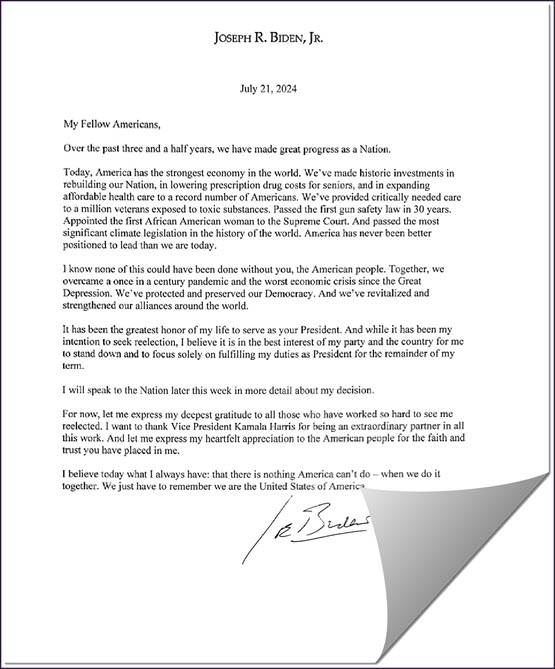
    The legal differences between a statement issued on personal stationery versus official White House stationery can be significant in several ways:

    When I typically write an article, I ground my points in thoroughly verified facts, ensuring that “WAYNE’S TAKE” provides reliable insights to my readers and the broader public. Today, however, I find myself navigating uncertain waters, presenting more of a “WHAT THE HECK is going on?” scenario rather than definitive conclusions.

    The President has seemingly vanished from the public eye, creating a ripple of confusion and speculation. Reports from the Las Vegas Police Department suggest that during his recent visit, there were indications of a potential medical emergency, prompting sudden changes in his schedule to facilitate medical attention. Earlier, it was disclosed that he tested positive for Covid-19. Covid-19? The virus he has been both vaccinated and boosted against to safeguard his health?

    Adding to the intrigue, just a week after President Biden emphatically declared his intention to remain in the 2024 race, asserting his health and capability to serve another term, a tweet from his account announced his withdrawal from the race, endorsing Vice President Harris as the nominee. This announcement, accompanied by a letter to the American people on personal stationary rather than official White House letterhead, has raised eyebrows. Questions about the authenticity of the signature, rumored to be an image, further complicate matters.

    Additionally, there are murmurings about Vice President Harris’s eligibility to serve as President due to her parents’ naturalization status at the time of her birth. While I’m opting to set aside the conspiracy theories for now, I believe it’s crucial to focus on the legal aspects of the President’s letter. Instead of conducting my usual deep dive into legal precedents, I turned to ChatGPT for insights into the matter. Here’s what it had to say:

    THE BELOW IS FROM CHATGPT…. Legal Questions on Communications from the President of the United States.

    1. Official Capacity vs. Personal Capacity:
      • White House Stationery: When a statement is issued on official White House stationery, it is generally considered an official communication from the President of the United States in his official capacity. This can carry the weight of government policy, directives, or official positions.
      • Personal Stationery: A statement on personal stationery is typically considered a personal communication from the individual who holds the office of the President. It does not carry the same official weight and is generally interpreted as the personal opinion or sentiment of the President.
    2. Legal and Constitutional Implications:
      • White House Stationery: Statements on official stationery can have legal and constitutional implications, potentially influencing executive actions, policy implementations, or international relations. They may also be subject to public records laws and oversight by other branches of government.
      • Personal Stationery: Personal statements are less likely to have direct legal or constitutional implications, as they are not official acts of the office. However, they can still impact public perception and political discourse.
    3. Accountability and Transparency:
      • White House Stationery: Communications on official stationery are subject to transparency requirements, including records retention policies and potential oversight by Congress or other entities. They are part of the official record of the presidency.
      • Personal Stationery: Personal communications may not be subject to the same level of scrutiny or records retention requirements, though they can still be subpoenaed or investigated in certain legal contexts.
    4. Implications for Policy and Governance:
      • White House Stationery: Official statements can influence government agencies, shape public policy, and signal official government positions domestically and internationally.
      • Personal Stationery: Personal statements are more likely to be seen as individual viewpoints or informal communications, without the same directive power over government operations.

    SUMMARY

    In summary, the use of White House stationery signals an official communication with potential legal, constitutional, and policy implications, whereas personal stationery indicates a more informal, personal message with fewer official ramifications.

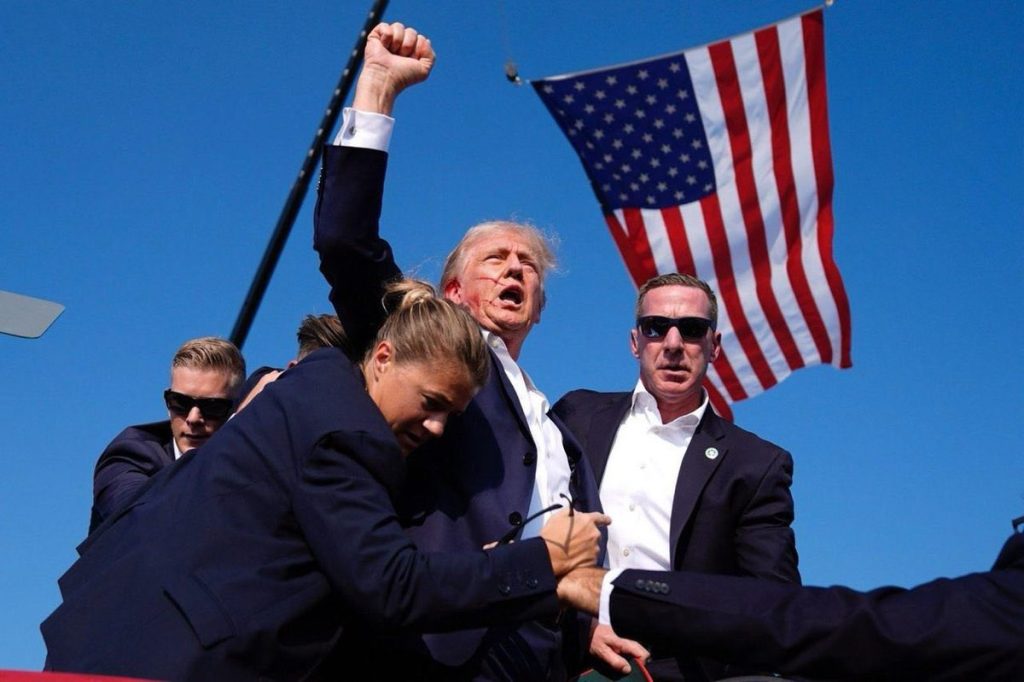
    WAYNE’S TAKE! So, coming from the legal profession and being accustomed to investigative and analytical processes, I find it very uncomfortable that there is virtually no communication with President Biden, Dr. Jill Biden, or any medical authority that can give the American people an update on his health. This unease is exacerbated by the recent assassination attempt against former President Trump, the leading contender for the White House in the 2024 election.

    It is unnerving that VP Harris has reportedly been actively handling presidential duties and meetings. Furthermore, a senator will preside at Netanyahu’s speech to Congress after Harris declined to attend. America’s Secretary of State did not even greet our nation’s ally at the airport. Is Biden alive? Dead? Incapacitated? Was the letter announcing his official withdrawal from the presidential race issued on his personal stationery to avoid congressional oversight or legal issues from future claims of the letter not actually being drafted or signed by the President? There are many questions this situation raises.

    Tied into the assassination attempt on former President Trump, the Director of the Secret Service appeared before a congressional oversight committee yesterday, under subpoena, and failed to directly answer over 80% of their questions, nor according to the Congressional members did she bring the documents requested within the subpoena. Nine days have passed since the shooting, and the USSS director could not even provide Congress with an accurate timeline of the shooting, the shooter’s activities, or the USSS sniper’s reporting of identifying the shooter. I, for one, call BS on that! Sorry for the strong language, but we already have parts of the timeline clearly documented through video evidence from dozens of sources, testimonies, and statements from witnesses. For her to deny having any part of the timeline documented is clearly a politically motivated position to take.

    One last question I wish to raise to all those investigating the assassination attempt and the killing/critically injuring of innocent Americans at the Trump Rally: is anyone following the money? One of the first steps in the course of an investigation is to determine the motive. In my list when investigating organized crime, money is the number one motive, power is the second, and revenge is the third. While looking at following the money, I noticed yet another very suspicious element. Within 24 hours of the assassination attempt on former President Trump, DJT public stock was shorted by millions upon millions! Who would short his stock just after his landslide win at the presidential debate and days before his acceptance at the RNC for the nomination as the next 47th President of the United States? There is a high probability that whoever made such a massive short call on DJT’s stock on July 12th was counting on a life-changing event that would take Trump out of the race, thus producing a huge financial windfall. If the FBI, the SEC, and the USSS are not investigating the company, its directors, its investors, and anyone else associated with shorting the stock, then we have a good idea what side of the political spectrum they are sitting on and how far they are willing to go to eliminate their adversary. And that’s WAYNE’S TAKE!

    Since this Article has been written to help bring to light questions that need to be raised, and solicit possible answers from you the reader, providing me with YOUR take, I welcome you to reach out. Wayne’s Take is not an open forum for off the wall conspiracy theories, or far left leaning anger issues. So your comments will be reviewed and I will follow up on this Article with additional notes and responses to those that reach out to me. Thank you and may God bless our country and protect our citizens, our elected officials and President Trump as we enter into a renewal of our country’s greatness in the years to come.

  • A Picture is Worth a Thousand Words

    A thousand words can’t not come close to express our feelings over the injustice and attacks upon former President Donald J Trump.

    Today, July 13th, 2024, the nation witnessed a moment of unparalleled resilience and defiance. Former President Donald Trump, delivering a stirring speech at a campaign rally in Pennsylvania attended by thousands of supporters, became the target of an assassination attempt. The crowd’s fervor and the rally’s energetic atmosphere were shattered as multiple shots rang out. In a split second, the President grabbed the side of his head, where he had been grazed by a bullet/or shattered glass from his protection shield, in the ear. The photograph that emerged from this harrowing incident captures a scene that will undoubtedly be etched in history—a defiant leader, fist raised, surrounded by Secret Service agents, with the American flag waving majestically in the background.

    The image of President Trump, standing resolute in the face of an assassination attempt, sends a powerful message. It is a testament to his unyielding spirit and his unshakeable commitment to the ideals of freedom and democracy. In that moment, as he pumped his fist in the air, Trump embodied the rallying cry of “FIGHT FIGHT FIGHT,” a call to action for all Americans to stand firm against the forces of evil that seek to undermine the nation’s core values.

    The rally, held in a large open venue, was brimming with patriotic fervor. Supporters waved flags, chanted slogans, and displayed banners expressing their unwavering support for the former President. The atmosphere was electric, filled with hope and determination. Yet, in an instant, the joyous occasion turned into a scene of chaos and fear as the shots echoed through the air.

    Despite the sudden attack, President Trump remained undeterred. The photograph captures his steely determination and his refusal to be cowed by threats to his life. It is a vivid portrayal of a leader who, even in the face of mortal danger, stood tall and inspired those around him. This image, more than any words could convey, symbolizes the fight against tyranny and the struggle to uphold the nation’s freedoms.

    Tragically, the attack claimed the life of a true patriot in the crowd. A supporter, whose identity has not yet been released, was killed by the gunman. Two other individuals were injured and taken to the hospital. The loss of life is a somber reminder of the very real threats faced by those who stand up for their beliefs and support their leaders.

    The would-be assassin was seen by witnesses in the crowd performing a military crawl maneuver on a rooftop next to the rally. These witnesses reportedly advised law enforcement minutes before the shots were fired, yet no action appeared to have been taken to protect the President. This lapse in security will certainly be investigated. The Secret Service reportedly shot and killed the shooter. Authorities are conducting a thorough investigation to uncover the details surrounding the attack. What is clear, however, is that this was an act of evil, an attempt to sow fear and chaos in the heart of American democracy.

    President Trump has yet to make a statement following the attack. His supporters and Americans across the nation await his words, knowing that his resolve remains unshaken. His future statements, like the photograph, are expected to resonate deeply with his supporters and with Americans across the nation.

    I truly believe, “The WAR is on,” as many of his supporters have also declared, emphasizing the ongoing battle between good and evil in the country. We speak of the forces that seek to control lives, undermine freedoms, and dismantle the American way of life. I assert, this attack, was a desperate attempt by these forces to maintain their grip on power. But, I assured the nation, America will prevail. The spirit of true Americans, embodied in the resilience shown by the President himself, will never be crushed.

    The photograph of President Trump, fist raised in defiance, will undoubtedly go down in history as a symbol of the nation’s resolve. It captures a moment of profound significance, a visual representation of the determination and dedication that define the American spirit. This image is not just worth a thousand words; it is a testament to the enduring fight for freedom and the unwavering belief in the nation’s ideals.

    As the investigation gets underway and more details emerge, the nation remains united in its resolve. The attack has only strengthened the resolve of those who stand for freedom and justice. The photograph of President Trump will serve as a reminder of this resolve, a beacon of hope in the ongoing struggle against tyranny.

    In conclusion, the events of today, July 13th, 2024, have left an indelible mark on the nation. The image of President Trump, standing defiant in the face of an assassination attempt, will be remembered as a powerful symbol of the fight for freedom. It encapsulates the spirit of resilience and determination that defines America. As the nation moves forward, mourning the loss of a precious life today, this photograph will serve as a rallying point, a visual testament to the unwavering commitment to the ideals that make America great. Indeed, a picture is worth a thousand words, and these thousand are mine as I pray over the protection of President Trump this day and each day forward, and as I pray for the soul lost and over their family as they grieve their loss.

  • Game Over … Biden Out!

    The 2024 Presidential Debate was the end of the Biden Administration.

    The 2024 Presidential Debate was the end of the Biden Administration. Watching tonight’s Presidential debate was painful within the first few minutes, watching Joe Biden attempt to interact or defend his failures as President. Looking at the two candidates, you would think they were 25-30 years apart in age.

    The debate, hosted by CNN, had rules that were unprecedentedly restrictive and biased towards the incumbent Biden. Despite this, President Trump showed remarkable calm restraint throughout most of the debate, highlighting Biden’s gross negligence on issues ranging from the border, to loss of military lives, to Ukraine, to the economy and more.

    The painful part was knowing that the man with his hand on the button, who could literally put us into WW3 tomorrow, is so out of touch with reality, unable to think clearly, and has such poor memory. The relief came from seeing a composed Trump ready to take the reins and steer the country back on course.

    The next question is: who will the Democratic Party choose to replace Biden? It certainly cannot be Harris. One might speculate that Obama will have a hand in the decision process and support whoever their nominee will be to avoid a landslide defeat in the November 4th election.

    A Painful Contrast

    From the outset, the contrast between the two candidates was stark. Biden’s attempt to engage and defend his administration’s track record fell flat. His age and cognitive abilities were on full display, making the debate uncomfortable to watch. It was evident that the years had not been kind to Biden, and his ability to lead was seriously in question.

    On the other hand, Trump demonstrated a level of composure and control that was impressive. Despite the biased format and restrictive rules, he managed to address critical issues with clarity and conviction. His criticism of Biden’s handling of the border crisis, the economy, and foreign policy resonated with viewers who have felt the impact of these failures firsthand.

    CNN’s Bias and Debate Rules

    The debate, hosted by CNN, was marked by unprecedented restrictions and obvious bias. The rules seemed designed to protect Biden from tough questions and limit Trump’s ability to challenge him effectively. This one-sided approach was evident to anyone watching and added to the frustration of those hoping for a fair and balanced debate.

    Despite these challenges, Trump maintained his composure and focused on the issues that matter most to Americans. His restraint and ability to stay on message were a testament to his experience and understanding of the political landscape. At one point after the candidates exchanges a more personal attacks on character, Trump’s comment about “Let’s not act like children, was met with Biden’s comment of “you’re a child”. I may have not remembered the statements verbatim, however close enough to where those watching could see that Biden had zero ability to keep the debate banter under control.

    Biden’s Cognitive Decline

    Perhaps the most painful aspect of the debate was witnessing Biden’s cognitive decline. His inability to articulate his thoughts clearly, his frequent memory lapses, and his overall confusion were troubling to watch. It was a stark reminder that the leader of the free world is not up to the task of leading the nation through these challenging times.

    The prospect of Biden continuing in office, with his finger on the nuclear button, is a chilling thought. His lack of awareness and cognitive decline pose a serious risk to national and global security.

    The Democratic Party’s Dilemma

    With Biden’s performance in the debate confirming his unsuitability for another term, the Democratic Party faces a significant dilemma. It is clear that Harris is not a viable option to replace him. Her approval ratings are low, and she lacks the support needed to secure a victory in the upcoming election.

    Speculation is rife about who the Democrats will turn to in this critical moment. Many believe that former President Obama will play a crucial role in the decision-making process. His influence and support will be vital in selecting a nominee capable of mounting a serious challenge to Trump and avoiding a landslide defeat in November.

    Conclusion

    The 2024 Presidential Debate marked the end of the Biden Administration. The painful reality of Biden’s cognitive decline and inability to lead was on full display. Despite the biased format and restrictive rules, Trump emerged as a composed and capable leader ready to address the nation’s challenges.

    As the Democratic Party scrambles to find a suitable replacement, the influence of key figures like Obama will be pivotal. The stakes are high, and the future of the nation hangs in the balance. The November 4th election will be a critical moment in American history, and the outcome will shape the direction of the country for years to come.

    As we approach the 2024 Elections, I wish to extend my gratitude to FarSuperior’s newly formed Politics Board of Directors. Both the Chair, Suzanne Sharer, and Director Jim O’Connor are actively working to identify the best candidates for our local community to support here in Arizona, to ensure the restoration of the State of Arizona to a powerful state leading the way and protecting our citizens, as well as the rest of the country, from the invasion of our southern border, the drugs entering our country, and the child trafficking. All of these are the direct results of the current administration in Washington, DC’s plan to remake and weaken America and the freedom we enjoy.

    June 30th, 2024 – Update. I have had the opportunity to watch the debate through RFK Jr’s debate website… www.TheRealDebate.com It would have been the respectful and responsible thing to do by CNN to have included the Independent Candidate. Personally I see more and more people moving away from both parties and registering as an Independent. RFK Jr is a voice that should be included and Americans should have him as a choice within the election. If the election was held tomorrow, and it was a fair election without any manipulation of the voting system, Trump certainly would win by a landslide. While at the same time, President Trump would be well advised to bring RFK Jr into his Administration in order to bring real balance of representation of the American people. RFK Jr’s voice, history, and policy positions do represent a blend of all three parties. While I do not agree or support all of his positions, I support and believe in America and the right of all our people to have the choice to decide who should be leading our nation. This is just MY TAKE, and not the opinion, or position, of FarSuperior’s Political team.